Facebook recently announced their latest addition to the social platform, a ‘coming out’ life event. Created to celebrate ‘coming out’ as a momentous feat, the feature is a new timeline event put forth for LGBT users to share their initial acts of self-disclosure. Some have commended Facebook’s effort to incorporate this event into the platform. However, LGBT users aren’t as accepting, interpreting the development as a further misrepresentation of the LGBT community via the World Wide Web.
Mark Runacus, president of PrideAMuk said:
“Coming out isn’t always a positive experience. Some are pressured into it, others are outed, and many still can’t come out. “…Coming out isn’t something we do once in our world. I come out almost daily.”
Such an audacious technological implementation imposes the question: are businesses using technology insensitively?
Real-time gone wrong
With customer service chat-tools integrated into social platforms and websites, the need for online businesses to provide 24/7 interaction has become focal. Something as small as a delayed response to an instant message, can force a user into hopping over to the competition. But can businesses be grossly reactive? Yes they can. Here’s an example of how Epicurious a food brand used the Boston Marathon bombings as a marketing ploy. Instantaneously reacting to the tragedy, Epicurious sent out two tweets, to 385,000 followers that read: “Boston, our hearts are with you. Here’s a bowl of breakfast energy we could all use to start today…”
This was worsened with a scripted, automated follow-up that read: “We truly regret that our earlier food tweets seemed insensitive. Our hearts and prayers are with the people of Boston.”
‘Creepy’ Personalisation
Although stats confirm personalisation does work when engaging and converting customers, an awareness of what is and isn’t appropriate is lacking for businesses. CEB Marketing and Communications polled 390 consumers to find out of how users felt about “online ads that use details about what I’ve done.” 73 percent answered negatively, with 49 percent specifically saying they found it “creepy.” Additionally, when marketers were questioned on what they thought of personalised ads, a mere two percent believed consumers would be uncomfortable with the practice. The evidence suggests how unknowingly, marketers through persistent first-name contact, inappropriate timing and emotional blackmail are unintentionally detracting consumers from their services.
Its clear consumers aren’t supportive of intrusive technology – are you aware of the potential damage?
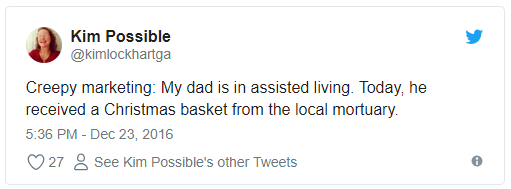
See below for an example of how technology failed one business, encouraging Kim Possible, a twitter user to publish her experience.
Targeting a consumer’s behavioural activity
Consistent personalised emails tailored to a consumer’s behavioural activity can be manipulating. From after attaining a user’s browsing history and first-name, brands can direct their product to individual consumers, luring users into shopping their service – “Hi Dave, we’ve acknowledged you’ve relevant skills and education that make you a suitable candidate for our course, which is discounted currently, for a limited time only.” This example, exhibits how an ad can falsely sell a consumer services using invasive marketing tactics for their own gain. Additionally, some ads can be distasteful, conjuring up sensitive issues that relate back to past behavioural activity on the web.
Ways to market more sensitively:
- Put customers’ needs at the forefront of your advertising strategy with useful, relevant and timely recommendations.
- Learn your audience; conduct surveys and opt-in forms to discover relevant information about your audience that’ll help to tailor your ad insights to a specific demographic. Compile precise data sets to optimise your marketing efficiency.
- Ease off on Ad Words; build your brand tone organically through social posts and blog content to increase engagement naturally. Albeit, adverts are encouraged, but refrain from bombarding; let a consumer’s wants / needs drive them to your business, instead of driving them away with ad-overload.
- Ask consumers what they think of your services. Take on board their opinions and reviews, to further enhance your services that’ll pay off in adapting your marketing approach too.
- Be clear of your data policy services on your website, and through your social channels. Communicate with your audience; make it clear that your business doesn’t misuse customer data and only keeps hold of it for as long as required. This eases the blow for when users do see ads from your business, as they’re aware of your clear and honest data policies.
Is custom-marketing damaging your business? Is technology becoming invasive? Let us know your thoughts.