Despite the introduction of GDPR, data-breaching scandals are still at staggering heights. This combined with a lack of reassurance from businesses, who aren’t making their data handling policies visible for consumers, isn’t encouraging.
Salesforce’s “State of the Connected Customer” report states that: 95% of customers say they’re loyal to companies they trust even though 54% don’t believe companies have their best interests in mind.”
This implies how although consumers will commit to brands who they can definitely trust, they’ve still reservations concerning their motifs.
Users are still also receiving an alarming amount of spam ads and unwanted newsletters, despite the avalanche of ‘opt-out’ emails which flooded inboxes across Europe prior to the GDPR deadline. This has further imposed doubt on consumers, causing web users to question the data laws in place, and opt out of marketing permissions.
See below for tips on how to build brand trust, so that consumers confide in your brand.
Talk to your audience
Most businesses by law protect the personal information of users; they hold data for only the necessary amount of time, use secure processing methods and follow all lawful data regulations, yet this isn’t always made apparent for users.
Businesses are failing to reassure users on the safety of their data. According to statistics from a recent survey conducted by OnePoll for the Chartered Institute of Marketing, “48% of consumers do not understand where and how organisations typically use their personal data.”
- Businesses must promote their privacy policies to comfort consumers. Ensure your policies are defined, informative and easy to understand across your website and promote them via social channels. This will help put consumers at ease, even if they don’t understand your policies; as long as your procedures are clearly outlined, then consumers will feel as if their private details are being handled responsibly.
- Businesses must expand on their requests. For instance, if you’re asking for a specific field of information from a consumer, then explain why you need it, and what advantages the consumer will receive from providing you with it.
Be consistent
The complex nature of the digital age means that consumers are consistently weary and sceptical of new developments, cyber threats and the safety of their consumer data.
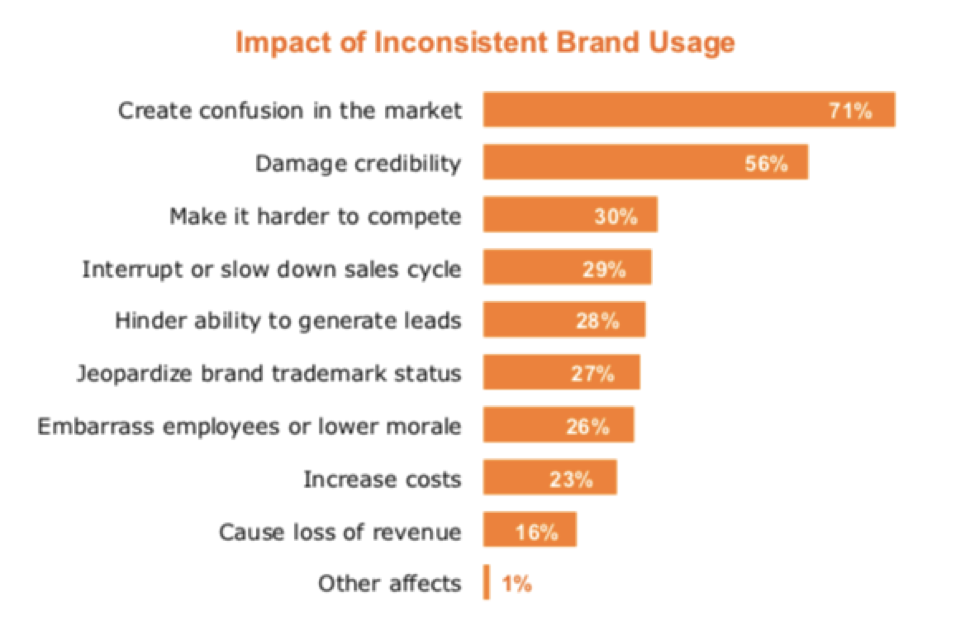
Thus if brands are using conflicting messaging across their outlets, this can seriously damage their relationship with consumers. Recent studies confirm how misleading brand usage is “conflicting and discouraging” for online users.
By employing a consistent tone across their website and social channels, businesses can effectively retain and convert consumers.
To do so, businesses must ensure all workers involved within the business – from the sales advisors to the digital marketers – are in sync.
Stats prove that a consistent tone across all communications helps consumers to retain trust in a brand, of which in turn produces sales.
See, Lucidpress’ bar chart (based on statistics) demonstrating the effects of inconsistent brand usage:
Share good reviews
By experiencing positive reviews users will trust a business’ services. Thus it is important for a business to highlight and share pleasant consumer experiences via their website and across social media channels.
And if a business hasn’t many reviews to share, then we’ve a simple solution; recycle them! Businesses can edit the format of a review so that they can publish it through a number of different marketing communications. For instance, a review can be made into a graphic for social, a banner for a website, a gif for an e-blast, and can be printed onto paper flyers.
This technique prevents businesses from posting the same post repeatedly via the same platform, of which can appear over-saturated. It also enables businesses to reach out to a wider target audience via a range of advertising mediums.
Offer incentives
Coca Cola was the first company ever to distribute a coupon in 1887, shaping the future of e-commerce forever. The marketing ploy – of which is just as effective today – can be used by businesses to encourage users to carry out an action such as part with their data.
Consumers are more willing to submit their data if there is an incentive for them. This strategy is effective, as it isn’t compulsory and consumers are able to earn a reward from doing so, however their compliance is entirely self-governed.
Businesses can build long-lasting relationships with consumers by gifting consumers regularly.
Acquire a reputable figure
If consumers are able to associate a reputable figure with a brand, then this will make a brand stand out amongst akin offerings, and appear more authentic.
Take the revolutionary Steve Jobs, for example, his workshops and presentations resonated with audiences everywhere, and still continue to do so today. His performances were passionate, emotive and real, accumulating millions in sales.
Putting a face to a brand can inspire users to put trust in your brand, shop and engage with your services.
Offer choice to consumers
Businesses can give consumers choice when requesting their user data. This makes it more likely for them to cooperate, as they don’t feel forced into giving away too much. By only making the most important fields mandatory, consumers will feel as if they are in control of what they want to reveal to businesses, putting them at ease.
To further reassure consumers, businesses can also explain why they need certain details from consumers, “we need your email address so that we can send you your purchase receipt”.
Seal of approval
Lastly, a recent study conducted by CXL institute found that when trust logos and site seals are exhibited on a website they provide comfort to users.
Statistics prove consumers are more likely to trust and shop from a website which displays a “familiar stamp” such as a secure payment icon, than one without. This is despite many consumers not knowing what the different types of safety icon represented.
Such credible-looking logos help consumers to feel protected online as they part with personal user data such as payment information.
Does your website appear credible? Is your brand having trouble with trust-issues following some bad reviews? Leave us a comment on Facebook or Twitter with your own experiences of brand trust.